Showing posts with label Ancient History. Show all posts

Wednesday, August 12, 2015

Egyptian Kits Part Three: Wizards

As I set forth a few weeks ago, this is the conclusion of Parts One and Two.

Wizard Kits

Amulet Maker
Amulet makers are minor wizards much like scorpion charmers. They are looked down on by the scholarly caste, clerics, and real wizards alike. However, the common folk often buy charms from these masters of spirit-lore.
Requirements: Wisdom 12
Role: Amulet makers are not wizards in the same sense as Hekau are. They do not study spells or enact rituals to call forth magic from the Golden Breath. Instead, they focus on the creation of small magical items and potions which they can either sell or use themselves.
Amulet makers may sell their amulets to the common folk and serve as a local wise-man. They may also reside in noble households and make amulets for the powerful. Many temples often keep amulet makers on hand to equip their servants and clerics with powerful magical items.
Weapon Proficiencies: Since it is needed to make their charms, a dagger is always kept on hand as a free proficiency slot.
Nonweapon Proficiencies:
Bonus Profs: reading/writing (Desert Khewed), pottery
Special Benefits: Amulet makers may create amulets imbued with magical powers. Amulets can take any form, but are often simple seals worn around the neck, ankles, or wrists. The simplest amulets an amulet maker may craft are those that sold to common folk. These cost only 5 copper to manufacture in addition to whatever material it is made of (most often clay, formed by the wizard himself). They may have one of the following effects:
Protection Against Magic: +1 to saves vs. spell
Luck: +1 to saves vs. Breath Weapon
Strong-mind: +1 to saves vs. Petrification
Safety: +1 to saves vs. Rod
Ka: +1 to saves vs. Death

In addition to these simple amulets, Amulet Makers may also create amulets capable of storing wizard spells. While Amulet Makers must learn spells and keep them recorded on papyri, they cannot themselves use magic. Instead, they imbue their amulets with the ability to replicate the power of a spell. These amulets may be used many times, however they are prone to breaking from the strain of the magic contained within. Additionally, each additional time in a 24 hour period that they are used increases this strain. The following chart shows the spell storage capacity of various materials and the costs associated with producing a working amulet of those materials.

Amulet Material Cost Storage Failure Chance
Clay 5 copper 1 25/40
Bone 10 copper 1 25/25
Stone 10 silver 1 15/10
Copper 1 gold 2 15/25
Bronze 2 gold 2 15/10
Brass 10 gold 2 10/10
Iron 20 gold 3 15/25
Steel 20 gold 3 15/10
Silver 100 gold 3 10/10
Silver and Gold 500 gold 4 15/25
Gold 1000 gold 4 15/15
Gemstone 5,000 gold 5 10/10
Gemstone 8,000 gold 6 -10%/10
Composite 15,000 gold 7 -20%/10
Masterwork 40,000 gold 8 -40%/10

Add +10% failure chance for offensive spells
Add +5% failure chance per spell level
Add +/day% failure chance for every use within 24 hours

Amulet makers may also make magical items as any wizard of the appropriate level. They do not need to use a permanency spell, and any spell they have stored in their memory qualifies as one “being cast” for the purposes of making a magical item.
Special Hinderances: Cannot cast spells as normal wizards.


Hekau

Purity Rating
8 Gold all three effects
7
6 Electrum all spells cast at max effect
5
4 Silver +1 bonus to effective level
3
2 Copper +1 bonus to duration, damage, -1 penalty to saves
1
0 (average) spells cast normally
-1
-2 Iron -1 penalty to duration, damage, +1 bonus to saves
-3
-4 Tin -1 bonus to effective level
-5
-6 Mercury all spells cast at minimum effect
-7 Lead all previous three effects
-8 Profane no spellcasting

Sleep: Immediately after sleeping, the Hekau’s purity rating drops by two levels. Purity returns at a rate of 1 level for every three hours. Every six hour period following this without sleeping increases purity by 1 level (max level 7).

Eating: Immediately after consuming food, the Hekau’s purity rating drops by one level. This may be increased by the DM depending on how much food the Hekau has consumed. Purity returns at a rate of 1 level for every six hours. Every six hour period spent without eating after that adds 1 level purity (max level 6).

Ablution: The Hekau may pay 500 gold multiplied by his next purity level and that number of hours to positively increase his purity. This expenditure purchases time and materials in a sacred temple to perform the rites necessary to purify his body. Negatives are considered positives for the purposes of ablution. To achieve level 0, the wizard need only pay 250 gold and spend 30 minutes in ritual.

Sexual Impurity: Immediately after performing any kind of sexual activity, the Hekau’s purity level drops by three levels.


Contact with Corruption: Being exposed to corrupted food, flesh, or other rotting things will reduce the Hekau’s purity. These objects must touch the Hekau physically without intervening substances (ie, the Hekau may wear gloves to handle the dead). Each individual contact reduces the Hekau’s purity rating by one.

Wednesday, July 29, 2015

Egypt, or the Versatility of the Second Edition Part One: Warrior Kits

Second Edition AD&D can do many things. As I explored earlier this week, I can't seem to get it to do ablative armor, but there are a variety of vastly different settings it can successfully represent. One of the most successful campaign sets was Al Qadim, well known for being a complete conversion of the system, transforming it from a standard medieval setting to a much more cosmopolitan world that would be at home in the stories of Scheherazade. This complete conversion was achieved by means of kits. Long before I came up with the idea of the mundane kit series (see, e.g., Playing Servants Parts One, Two, or Three) I created a kit-based overhaul of the system to model not a medieval Arabian/Islamic but rather classical Egyptian model a-la Al Qadim.

I never completed the work, but it was intended to include an overhaul to the class system much as Al Qadim had done in ages past.

Warrior Kits


Temple Guardian
These warriors are dedicated to the service of a single cult, and often a single temple-site. They may serve as the guardians of the site or as its influence abroad, doing the bidding of the high cleric of that particular temple. They thus often come into conflict with other Temple Warriors during the violence between cults.

Requirements: None; all races and both genders are eligible.

Role: The temple warriors are drafted from the lower classes at a young age to be trained by their respective cult. They are considered to belong to the priesthood (though its outermost branch) and are thus permitted access to certain holy sections of the temples. They can expect to be allowed to stay within the precincts of a temple or within the priests quarters and often an entire platoon of temple guardians will be stationed in one temple.

They are also the arm of their temple’s might, enforcing its will abroad in the world and can be sent out on missions whether on their own, in small units, or accompanying priests of their cult. They are trained in the secret arts of literacy for, unlike slave-soldiers, they are expected to have some participation in cultic acts.

Weapon Proficiencies: Temple guardians must take their first two weapon proficiency slots in the khopesh and the scourge. They learn how to fight with the khopesh from childhood, and they teach other young temple guardians under fear of the scourge.

Nonweapon Proficiencies: Bonus Profs: reading/writing (Desert Khemri), religion (by cult)

Equipment: Temple guardians receive their equipment from the cult, and are never found outfitted otherwise at level 1. They begin play with 15 silver pieces and the following gear: a khopesh, a scourge, a tunic (or calasiris), sandals, shield, bronze scale armor.

Special Benefits: Temple guardians can expect to be given food and shelter in any temple that matches their cultic devotion, they are given extra attention by clerics who share their cult, and can frequent the secret inner portions of a temple. They also share a special status of power amongst the faithful.

Special Hinderances: Members of other cults will be suspicious and feel put-upon by the authority of these warriors. Cults who are directly opposed to the guardian’s cult will not be openly hostile, but may impede them in other ways.

Slave-soldier
Slave soldiers are people captured from the outland tribes that live beyond the borders of the Kingdom of Black Earth. These make up the majority of levies used by local cults, princes, and sepati.

Requirements: None; all races and both genders are eligible.

Role: Slave soldiers make up the bulk of any fighting force and any slave may be outfitted with gear and turned into a soldier. However, this kit represents specialized slaves who have been dedicated to fighting for their patron. Whether they serve a temple, prince, or other potentate (such as a merchant) they must almost always defer to those of non-slave status who work for the same employer.

Weapon Proficiencies: Slave soldiers are always taught to use a spear. They may not specialize in any one weapon at level 1, though they may do so later.

Nonweapon Proficiencies: Bonus Profs: endurance, one general skill (which they can use to assist their patron when not fighting)

Equipment: Slave soldiers receive 2d6x10 gold pieces at character creation. Anything they don’t spend is returned to their patron. They do not generally keep their own money, but turn everything over to their patrons. They may request better equipment from their masters.

Special Benefits: Slave soldiers are extremely hardy from years of training. They may receive a +1 bonus to constitution (maximum 18) or strength (maximum 18/00).

Special Hinderances: They belong, heart and soul, to their masters. If they raise a hand against their patron or disobey them, all of Khewed society will seek to turn them in or profit from their flight.

Noble Warrior
Noble warriors are members of the Per-ah, or noble houses. They are themselves Khewed nobility, highly trained in the art of war. They fight at the behest of their lieges, the heads of their family, and sometimes their temple. Noble warriors can also be found serving the sepati, or regional leaders.

Requirements: While any race or sex can be a noble warrior, they must be from a noble Per-ah or house.

Role: Noble warriors spend their time furthering the goals of their family, their sepati, or their cult depending on their bent. They often have great resources, though if they chose to lead their lives outside the normal structure of society by adventuring they generally give up their ties to wealth.

Weapon Proficiencies: Noble warriors must take the khopesh, the bow, and charioteering as weapon proficiencies.

Nonweapon Proficiencies: Bonus Profs: reading/writing (Desert Khemri), heraldry

Equipment: Noble warriors begin play with 2d6 x 100 gold. They don’t have to give any of it back, even if they don’t spend it.

Special Benefits: The house of descent from which a noble warrior comes may assist them in times of need. Likewise, they may have many contacts amongst the middle or upper nobility. Noble warriors receive a +2 bonus to all reaction rolls with other nobility.

Special Hinderances: Nobles of opposing houses and many clerics will hinder the goals of noble warriors, as they represent the power base of their own house. Nobles directly opposed to the house of the warrior and all priests take a -2 penalty to reaction rolls (only one or the other of these bonuses can affect a single NPC).

Medjay Warrior
Medjay Warriors are the members of the nomadic tribes that roam the high desert beyond the bounds of Khewed. While many of these nomads may fit into other classes, most of them would be considered medjay warriors.

Requirements: None, other than being of nomadic background.

Role: The medjay is the average citizen of a nomadic tribe. They hunt, gather food, and track the desert wastes. For this reason, medjay are closest to the ranger class (but must be warriors). Most NPC medjay have no level, or are level 1. The medjay may become a tribal leader (though he will always defer to the Speaker-of-Spirits or a Hekau if there is one present).

Weapon Proficiencies: Most medjay are proficient with the khopesh and dagger. All medjay must spend a slot to be proficient in bows.

Nonweapon Proficiencies: Bonus Profs: riding (camel) or riding (horse), tracking, one food-gathering skill

Equipment: Medjay recieve 2d4 x 10 gp to spend on equipment and may keep the rest. They cannot purchase metal armor.

Special Benefits: Medjay may track in the desert exactly as rangers normally do. In addition, medjay may barter or trade for closer to the precise value of their goods within their home tribe, and as long as they do not desert their tribesmen or acculturate to the city they receive a +2 reaction bonus when interacting with their tribe.

Special Hinderances: Medjay (like most desert folk) are uncomfortable in the great cities of Khewed. They have a -2 reaction penalty when interacting with city folk, and find trouble bartering or haggling with them.

Slave Driver
There are certain men who have no qualms about using others to do their dirty work. The easiest way to do this is to purchase and train slaves. Slave drivers send their men into combat to their death for money; they are most frequently employed as mercenaries by nobles or temples.

Requirements: Slave drivers can never be good.

Role: Slave drivers hire out their stables of slaves to complete important work in society. In ancient Khewed all public works were built and repaired by volunteer peasants at the order of the priest-king or Nesut-Bi’it. In modern Khewed, some of this work is taken by the cheap labor of slaves. Additionally, the forces of the cults and the princes are often supplemented by teams of slaves. Slave drivers are private slave-owners who hire out their wares.

Weapon Proficiencies: Slave drivers focus on non-lethal weapons and daggers; their choices include the whip, the scourge, the club, the bronze axe, the dagger, and the net.

Nonweapon Proficiencies: Bonus Profs: heraldry, leadership

Equipment: Slave drivers begin play with regular warrior cash and also a single slave of average quality. 

Special Benefits: Slave drivers get several special benefits. The first is that they may command a number of slaves equal to one half their level in combat; if they do this, they need not share xp equally with the slaves. Instead, their own xp allotment is halved and one half is distributed amongst their slaves who participated in the battle. They may also encourage slaves not to run; if a slave must make a morale check, the slave driver may choose to whip or scourge him to convince him to stay (or merely menace him with the whip). If this occurs, the morale check is rerolled and the slave driver makes an attack against the slave. He may choose to miss, dealing no damage. If he strikes the slave, he deals normal damage and the slave’s morale roll is modified by the amount of damage done. However, if he does more than 2 points of damage, the modifier is negative!

Special Hinderances: The slave driver must feed and house his slaves from his own income. If he maltreats his slaves too badly, he may be executed and his slaves made free men.

Husbandman
In the Old Kingdom, all armies where composed of conscripts called up from the great sepati farmlands to fill army quotas. In the New Kingdom under the Akhemian rule armies are mostly made up of slaves captured from the outland and desert regions. But there are still farmers, herdsmen, and folk of the land living in Khewed, and some of them choose to put down their farmer’s tools and take up the sword.

Requirements: None

Role: Husbandmen and -women are the every-day inhabitants of Khewed. Commoners who generally own some land of their own or work on the great farm-plantations of the sepati or the nobles, they serve as conscript-soldiers when the Ahkemian priesthood determines Khewed needs defense above and beyond her slave armies. Generally, however, they can be found tending to the land. This kit represents the children of a husbandman who decided to evade their father’s fate, or the husbandman who has abandoned his place as a farmer.

Weapon Proficiencies: Husbandmen may only begin play with the following weapon proficiencies, though they may later acquire others: Sickle, flail, scourge/whip, dagger, adze.

Nonweapon Proficiencies: Bonus Profs: any two relating to farming, fishing, papyrus making, or herding.

Equipment: Husbandmen begin play with much less money than normal warriors. They begin with 3d4x10 gold.

Special Benefits: The lower classes believe firmly in the Khewedi society and the truth of the cults and the gods. They receive a +1 bonus to-hit and damage when fighting any enemy of Khewed or outsider. In addition, their generally unshakeable faith lends them a +1 bonus to all saves vs. mind affecting magic or fear when in the presence of a friendly priest of any cult. These benefits may be lost over time if the PC becomes disillusioned with Khewed or the cults.

Special Hinderances: There are fears no acculturation can shake. One of those is the sacrilege of striking a servant of the gods. Husbandmen take a -2 penalty to-hit when attempting to strike a cleric of any Khewedi cult.

Laborer
Laborers break stone, chop the rare wood of Khewed, transport goods, or otherwise do backbreaking work.

Requirements: Strength 13, Constitution 14

Role: Laborers are the workforce of Khewed. While artisans do work requiring delicate hand-movements, laborers haul stone, work quarries, and pump furnaces. They may be smiths, masons, carpenters, or bricklayers. The one thing they have in common is the difficulty and exertion required for their job.

Weapon Proficiencies: Laborers may take proficiency in any weapon related to their job. These often include axes, picks, hammers, and clubs.

Nonweapon Proficiencies: Bonus Profs: endurance, any one other relating to their job
Equipment: As per a normal warrior.

Special Benefits: Laborers are much more difficult to exhaust in the desert heat than others. They spend most of the day beneath the beating sun, doing work that would cause a lesser man to faint.


Special Hinderances: Laborers may not begin play with a weapon specialization.

Friday, January 16, 2015

Cults and Churches and everything in-between

In between writing long briefs and reading vast treatises of law I've been delving into some classical history. Plutarch, Tacitus, and Suetonius were my most recent forays, and it occurs to me that there is an interest disparity between the way the pagan classical world worshipped and the way characters worship in D&D. I don't know if I've found a solution that will bring the 10th Age and the historical world in harmony yet (admittedly, some of the 10th Age religions do follow this standard, but it was more because I couldn't envision how a grand-scale church would function for that faith).

The idea runs thusly: every temple-site in the classical world appears to have been an independently operating cult. That is, a temple to Apollo at Athens and, say, the temple-complex at Delphi appear to be fully independent organizations without shared hierarchy or contact. Whichever iteration of a cult has the most sway at any given time determines which is seen as the "leading" version of the faith, and they are all acknowledged to worship the same deity, but in many cases the individual cults represent different incarnations or aspects of the deity. This can most clearly be seen in the many versions of Jupiter or Mars worshipped by the Romans—Jupiter Capitolinus, for example, put up against Jupiter Fulgore. In his guise as Capitolinus (and in his temple located on the Capitoline hill) Jupiter was the patron of statesmen. In his guys as Fulgore, he was the dangerous thunderer.

It seems to me that Birthright actually got this more correct than normal D&D did, what with the regional temple-organizations that are frequently at odds (The Northern Temple of Haelyn, the Imperial Heart of Haelyn, etc.) It's an interesting dynamic, one which shakes the veil of medievalism even further, as the medieval West was dominated by an integrated church. Though various loci were semi-independent and though the power in the early middle ages resided mostly in the local level (in the hands of bishops), it was nevertheless a different beast in its essential form from any of the many cults of the ancient world.

For now, I think, the temples of the 10th Age will grow slightly more fractured. I'm wondering if I should introduce oracular sights throughout the world as they were believed to be scattered through the ancient world—my own Sibyls, as it were. I'm still on the fence.

Wednesday, October 1, 2014

Friday, August 15, 2014

Orthodoxy and Orthopraxis

HERESY. A common word on the internet these days, mostly because its fun to say, and partially because its used commonly in the Warhammer 40k universe. But what exactly are heretics? Do they necessarily even exist in fantasy worlds? How can we better understand the way heretical movements functioned, what made them heretical, and why there were no heretics in diffuse religions? Well, we can examine the topics of orthodoxy and orthopraxy.

Orthodoxy — Right Belief.
This is a central tenant of the Catholic Church which was pushed to the fore by the co-opting of the previously underground church infrastructure by the Roman Empire. Orthodoxy reflects a necessity that everyone believes the same thing. Heresy (from the Greek root "to choose") cannot exist without a strong strain of ortho doxos, straight (or right, or true) belief. Thus, the presence of an orthodoxy inevitably hereticizes all other forms of belief. While this need not be universal and all-encompassing (There is only the One True God vs. When you worship this god, you must do it with this belief) but it tends to be.

Thus, one of the key elements to forming heresies is orthodoxic requirement in the faith. But orthodoxy requires other things to prop it up and promulgate it. They are (I) Centralized Authority, (II) Systems of Dissemination, and (III) An Orthodox Canon.

(I) Centralized Authority. In order to determine what qualifies as part of the orthodox canon and to administer the faith, some form of central authority is required. If a faith has no governing body, it cannot enforce orthodoxy. This can be a non-permanent assembly of all temple-leaders (such as a synod, convened to discusses matters of canon law and determine what does and does not fall under the rubric of the orthodoxy), a permanent position (such as the one held by the Roman Emperor, who could convene and threaten synods), or a permanent council (such as the rabbinical and Levitical councils which dominated Jewish faith). In any case, the central authority must pick and choose what belongs in the faith and what constitutes "right thought." If a faith is massively decentralized and has no overarching authority, it will be subject to many more permutations and local changes.

(II) Systems of Dissemination. Cathedral Schools, Rabbinical Schools, training centers, and public masses serve as systems of dissemination to the masses and the priesthood. Most pagan ceremonies of the ancient world took place in private, hidden from the regular laity, and training of priests was a secretive task that was performed in the sanctum sanctorum. But for a strict orthodoxy of correct beliefs to thrive, these training methods must be made open to scrutiny so they can be corrected. These channels are also required to transmit the central authorities version of the faith so they can be reproduced in the lower orders.

(III) A Canon. This isn't as strict a requirement as the others (though it is possible any or all of the three could be circumvented by processes I'm not thinking of at the moment) but it serves to cement orthodox practice. The canon doesn't just include holy writings or teachings, but also usually many crusted-on exegetical practices and treatises which help explain the original holy work. The Catholic example of this is the writing of the Church Fathers like Origen, Augustine, and Jerome, which explicates biblical writing and cemented it as a single strain of orthodoxy in the Late Antique Church, which chose certain interpretations over others.

Orthopraxy — Right Action.
Polytheistic Classical Antique religions are much more likely to be interested not in what their worshippers believe (because who cares?) but rather what they do. If you burn an offering to a god because you want something, you are participating in an exchange. The god may literally "eat" the incense and smoke of the offering as a form of sustenance (perhaps why more prayers make gods stronger) or it may be symbolic. However, the control of belief is much less important than the control of actions. Temples want sacrifices, they want loyal worshippers who will make the right choices, and they rarely care if someone believes something outside their faith. You think Mars can fix your house? Fine, we don't think so and we won't make the sacrifice to him on your behalf, but that's your business.

Thus, it is clear that without the trappings of Orthodoxy, heresy cannot exist. Extremely variant views may be relatable to heresy within even an orthopratical view (for example, eating the dead in honor of Mars would be disgusting, unthinkable, and awful and a practice to stamp out) but even then, it's not so much the errant belief that is responsible as it is the errant action.

So look carefully over your setting and ask yourself again: can heretics exist?

Wednesday, August 13, 2014

A Scepter by Any Other Name

One of the most consistently viewed pages on this blog is the Symbology of Scepters, which gets looked at a few times each month without pause or interruption in its popularity. Recently, I've been reading a lot of Mesopotamian history and literature and I've come upon something I felt I should make public—

Scepters don't go back to Greece. Those long king-tall rods are even older.

The scepter is one of the meh handed down by Enki in the very dawn of time to the people of Eridu. The list of the meh includes:

  1. Enship
  2. Godship
  3. The exalted and enduring crown
  4. The throne of kingship
  5. The exalted sceptre
  6. The royal insignia
  7. The exalted shrine
  8. Shepherdship
  9. Kingship
  10. Lasting ladyship
  11. "Divine lady" (a priestly office)
  12. Ishib (a priestly office)
  13. Lumah (a priestly office)
  14. Guda (a priestly office)
  15. Truth
  16. Descent into the nether world
  17. Ascent from the nether world
  18. Kurgarra (a eunuch, or, possibly, ancient equivalent to modern concepts of androgyne or transsexual [6])
  19. Girbadara (a eunuch)
  20. Sagursag (a eunuch, entertainers related to the cult of Inanna [7])
  21. The battle-standard
  22. The flood
  23. Weapons (?)
  24. Sexual intercourse
  25. Prostitution
  26. Law (?)
  27. Libel (?)
  28. Art
  29. The cult chamber
  30. "hierodule of heaven"
  31. Guslim (a musical instrument)
  32. Music
  33. Eldership
  34. Heroship
  35. Power
  36. Enmity
  37. Straightforwardness
  38. The destruction of cities
  39. Lamentation
  40. Rejoicing of the heart
  41. Falsehood
  42. Art of metalworking
  43. Scribeship
  44. Craft of the smith
  45. Craft of the leatherworker
  46. Craft of the builder
  47. Craft of the basket weaver
  48. Wisdom
  49. Attention
  50. Holy purification
  51. Fear
  52. Terror
  53. Strife
  54. Peace
  55. Weariness
  56. Victory
  57. Counsel
  58. The troubled heart
  59. Judgment
  60. Decision
  61. Lilis (a musical instrument)
  62. Ub (a musical instrument)
  63. Mesi (a musical instrument)
  64. Ala (a musical instrument)

So we can see that the scepter springs from ostensibly the oldest civilized times when it was wielded by sacred kings of Sumerian city-states. The Greeks must have picked it up from the Mesopotamians; whether before or after the Anabasis is hard to say, but I'd wager they got it some time during the Archaic Period, because Homer talks about the rods of kings. Whether Agamemnon really had a rod of rulership is impossible to know, but Homer or roughly contemporary poets must have had the idea about the rods (scepters) by their time.

Monday, April 14, 2014

The Narrow Tread

I usually go through great pains, when designing dungeons, to make corridors that are at least 5' wide, and often include many that are 10' wide. The logic, of course, is purely gamist and has nothing to do with the considerations of the structure of the buildings. I want fighters to be able to fight.

All that is about to change. Moving through medieval structures in Florence has given me a better appreciation for the size of rooms and stairwells. Indeed, most medieval buildings don't have corridors at all, but rather rooms opening onto other rooms. However, I preserve them for dungeons on the grounds that most of these places are built in a substantially different style to the "modern" world of the setting. That being said, chokepoints conveniently occur at doors and stairwells in medieval buildings.

Now, stairs... I have never imagined a stairwell or a corridor of less than five feet would exist in a medieval building. I had never been inside the winding, twisting, crazy path of the Duomo stairs. They are easily 3' at their widest and continue upwards for 462 steps. The walk is grueling, and the space is suitable only for grappling and stabbing. Even a pike or spear would have a hard time being used in such confined quarters, as the stairs turn and turn and turn on themselves, leaving no room for the butt-end of the weapon to trail or be set.

So you'd better believe that narrow design is having a comeback. Roofs that are too low for standing up (like the excavated crypts and church below the Florence Baptistery, which is a great model for a dungeon), floors that are sharply canted, and all other manner of architectural nightmare should soon find its way into the 10th Age. Farewell to the spacious, simple, rectilinear dungeon design. Hello, ancient and medieval architecture.

Monday, December 30, 2013

Magica Conflictus Capit II: The magic of Late Antiquity

Having just finished reading Icons of Power: Ritual Practices in Late Antiquity, I think I'm in a good place to talk about real magical and ritual practices of Antiquity and how they can inform the design of fantastical systems of magic. The first and most important thing is, of course, to ditch the term magic, which was a polemic used to compare people with the hated Magians of Persia who were presumed to perform profane and unholy arts, particularly because they were said to sacrifice human beings to their gods (as first reported by the Father of History and Father of Lies, Herodotus).

Thankfully, there is actually some real antique evidence that rehabilitates or reinforces (or at least informs) the use of spoken-word spells and gestures, so I don't have to feel so damn bad about all that wizardly hocus pocus in my games (do I have to feel bad if it doesn't have historical precedent? Probably not).

The old divisions of magic/religion as elaborated by Frazier in the Golden Bough (magic demands things of supernatural beings, religion is a supplication) have been swept away by new theoretical frameworks. "Magic" itself is a negative term used to denigrate the religion of the Other and prove that it is somehow inferior to one's own. This can include branches of non-orthodox or orthoprax religions that the polemicist actually shares beliefs with.

The Types of Magic:

Magical Speech
This is the most similar to the magic of D&D and the Lord of the Rings. Janowitz discusses the use of language as a non-semantic, pragmatic tool—ie, language that carries no meaning as language but rather causes actual, automatic effects in the world. The most common instantiation of this magical speech in the Late Antique period is actually in the names of Gods and daimons (the kind of spirit that may be either good or bad, as according to Greco-Roman mythology, not the "demons" of Christianity, though those too fall under this heading as creatures compelled by or named by magical speech). Necromancers and magicians bind and control spirits for what Janowitz calls "automatic effects" that is, spells or formulae that are effective no matter what the original intention or semantic setting is. This is similar to the accidental out-loud reading of a magical tome causing the spell to become active; the effect happens because of the language.

The development of non-semantic expression and automatic effects is somewhat similar to the way that magic works in the 10th Age, so I'm pretty pleased with this. While the efficacy in D&D doesn't necessarily rely on messenger spirits (unlike the root of D&D magic, Jack Vance's Dying Earth) it still incorporates a number of important ideas from the antique world.

Performative Magic
Here's the meat of this blog post, the thing which you will probably find most useful—Janowitz's tables of rituals as described in the Book of Secrets, a Jewish text of (presumably, though like all Late Antique magical texts only versions from the 13th-15th centuries are extant) Late Antique origin. All these rituals are great.

Ritual Purpose: Healing
Ritual Practice: Burn incense, chant

Ritual Purpose: Destroy an enemy (creditor, etc.)
Ritual Practice: Fill vessels with water, smash vessels, tell spirit this is what you want it to do to your enemy

Ritual Purpose: Know future
Ritual Practice: Put written slips in oil, imprecation of the Sun

Ritual Purpose: Influence king
Ritual Practice: Write names of angels/spirits on the heart of a lion, adjuration to Aphrodite

Ritual Purpose: Enter presence of a king
Ritual Practice: Anoint self with mixture made from previous heart

Ritual Purpose: Bind yourself to a great woman
Ritual Practice: Collect your sweat in a flask, bury it under her doorstep, adjure spirits

Ritual Purpose: Speak to ghosts
Ritual Practice: Face tomb, hold oil and honey, adjuration of Hermes, singsong release chant

Ritual Purpose: Give enemy trouble sleeping
Ritual Practice: Bury dogshead with spells written on it nearby

Ritual Purpose: Light an oven in the cold
Ritual Practice: Write angel names on a sulfur lamp, place in oven

These are some of the most interesting rituals present in Janowitz's chapter on the Book of Secrets. She goes into detail about some of them, though it is extremely theoretical. It's a good book, though absolutely not necessary to play and enjoy any kind of game or even to enjoy fantasy. You know me, though: always looking for the next bit of real information to incorporate, study, or devour.

Tuesday, October 22, 2013

The Metaphysical Weight of History and Memory

This is a sort of companion post to the Life of the City. Unlike that post, this one is focused on the role of memory and history in the conception of the city.

Geographic locations act as memorial cues and assist in building civic memory. Networks of memory attach to loci, forming complex layers of inter-connected meaning. For example: the Roman empire erected civic memorials throughout their urban centers; the physical accretion of these memorials describe maps (the main procession route through which triumphs and other political processions would proceed) in their cities. Arches of triumph and the great pillars (such as Trajan's Column) are the most well known of these memorial accretions. An Arch of Triumph, for example, serves as a cue to remind the citizens of several things at once. The power of the empire is proven by the imperial ability to organize labor and material, reiterated by the triumphal military engagement memorialized on the arch. The soldiers depicted there are generic any-soldiers. Many fathers, husbands, and brothers served in the imperial military machine; seeing these generic soldiers was a way of allowing the memorial to function across all members of Roman society and to join the citizenry together as a sort of single body.

These powerful networks of meanings were intensely important to the ancient world. They were plied by the Greeks and the Romans, the Egyptians and Persians, the Sumerians and all the ancient peoples. They are still applied today: Mary Carruther's great example of the Lincoln Memorial which has become filled with meaning beyond Lincoln as it has survived in collective and architectural memory of Washington DC. It signifies Abraham Lincoln, the Civil War, Equality, and has the marches of time written upon it, perhaps most significantly the "I Have a Dream" speech of Martin Luther King.

As civil spaces acquire these sorts of connections and networks they become further integrated into the life of the city every single square, location, and façade is entered into an endlessly complicated conversation about the history of the locale. When designing cities, these types of stories are important to note. The steps of a temple aren't just "those steps over there." They were created for a specific, often rhetorical, purpose. Those steps are were countless zealots have assembled, the same place where public orations where given and perhaps where traitors where hanged. While PCs and readers can't necessarily be aware of these distinctions (at least not all at once) those who truly inhabit the city earn their spiritual citizenship by being aware of these sometimes conflicting but always overlayed histories and meanings.

In any culture that relies heavily on public ceremony to form memory, and on memory to form collective culture, the steps in constructing civic memorials are probably well-attested and understood. For example, no ancient culture would simply demolish something they wanted the citizenry to forget (or if they did, their strategy would not be complete) because instead of being forgotten it would be remembered as both complete and constructed AND destroyed. The ruin of the building would be a memorial cue that reminded the viewer of the building as it once stood. Instead, semantic networks are changed and overwritten, new buildings can be raised on the foundations of the old, one temple may be consecrated into the religion of another, etc. Semantic change is far more important a tool than the pick or the axe.

Tuesday, September 17, 2013

The Burning Glass and Reading Stones

Optics and lenscraft didn't really hit its heyday until well into the Renaissance, and even then the equations necessary to create extremely reliable lenses weren't developed until centuries later. However, the classical world did have its share of optical science (and the Arab philosophers after the Muslim Conquest had many interesting things to add to the science).

The first thing we'll look at is the so-called "burning glass." The most famous of these is, without a doubt, the lens of Archimedes of Syracuse which was said to set the ships of Rome on fire during the Punic Wars. Whether or not that's true, the burning glass did in fact exist in the classical world and was sometimes in the guise of a transparent urn full of water or of a series of joined mirrors. The sacred fires of classical Greek temples were not to be lit with profane sources, but rather directly with the sunlight—this was how that was accomplished.

Another important development that we can see represented by the Visby Lenses is that it was possible through practice to achieve a magnification technique not equalled by theory and equation until the late 1950s; the Visby Lenses might have been what were known as "reading stones." These are essentially glasses that don't go on your face but rather rest on the document you are attempting to read.

Just some things to think about the next time you want to dole out some treasure... or if you feel like creating some new and interesting magical items.

Tuesday, August 6, 2013

Pride of Carthage, a review

I'll admit it: I wasn't that thrilled with the beginning of Pride of Carthage by David Anthony Durham. It seemed pedestrian. Throughout, there was something about the use of language that was somehow blasé to me. Yet, my intense and developing interest in various bits and corners of history that I'm not well versed in (the Civil War, the Punic Wars, pretty much anything outside of 200CE-1350CE) has been growing exponentially.

The workmanly quality of Durham's writing at first detracted from my enjoyment of the book; I have no idea what New Carthage looked like, unlike the very clear image of Republican Rome I've formulated through reading, seeing the modern city, and watching countless Roman movies and television shows (movies about Rome, not from it). However, once the story really got rolling, the writing faded into the background for me before the grand drama of historical figures.

What Durham really captured well were the little quirks of the various commanders (extrapolated from their behavior in the histories) as well as the troubles of the campaign. Hannibal's inability to bring Rome to heel due to those men back home in Carthage who wanted him to fail, the march across the Alps, even the dealings of his men with the "straw-haired" barbarians. The most memorable characters have to be the Molochite Monomachus (a gruesome man with a gruesome devotion to the Devourer) and the Massyli prince Massinissa, who was condemned to exile.

Massinissa's attack on Numidia is perhaps the greatest moment of the book. All of the previous writing seems to somehow work in this section, clicking into place and providing a powerful resolution to one of the B-storylines.

If you're not interested in the Punic Wars, this novel probably isn't for you. If you are, and you're somewhat turned off by the blandness of the writing to begin with, don't despair. The book isn't really about the textures of the environment, but rather the textures of the characters within it. Give it a chance. By the time Hannibal Barca's crossing the Alps... well, if you still don't like it then, you can abandon his mighty army and shut the book. Before then, you really don't know what you're getting involved in.

Friday, July 12, 2013

Ancient Architecture and Building Design

Ancient Greek temple architecture, used a lot in my games
It's been a long time since I've interacted with maps from official D&D products. Or rather, it had been a long time before Thursday. I started playing some Planescape with the remnants of the Gangbusters group who were eager to do more Gangbusting but who I also was afraid to allow to get too far ahead of the rest of the gang. Since fully half the players had never played Planescape before, read the setting books, or played Planescape: Torment, I decided to start them all on Toril. That meant I could quickly go to the resources I knew: Shadowdale and the maps of the various buildings within. I went to go look at the Twisted Tower of Ashaba and I discovered...

That the place was laid out like a late Tudor manor house. It felt more like Downton Abbey than it did a medieval fortalice. There were lots of hallways and rooms that branched off of them. There were big hallways that served no function other than to impress those coming through them. I was asked by a player as I described the entrance hall: "Are there any trestle tables in here?" Stunned, I answered no. Why did he react that way? Because for five years I've been totally insulated from old D&D standards and designing all of my buildings based on medieval and ancient floorplans.

These are the models I've been working off of, and it has been hard as hell. I only now realize why I've been struggling to design dungeons that are varied, interesting, and challenging: they were never meant to be designed as though they were the ruins of real ancient structures. But nevertheless, I've managed to create my own lingo of dungeon, castle, palace, and temple design based on ancient sources. Most temples, for example, are either hypostyle halls or tholoi in the 10th Age. This means that there are no twisting corridors or back rooms: there is an exterior pediment, an interior space, and a sanctum sanctorum. Anything else I have been putting underground because it simply doesn't fit in the layout of an ancient temple.

Tholos type temple construction
Hypostyle hall (Egyptian) with egyptian/early Milean pillars


Of course, I also use a lot of medieval stuff as well; manor houses and the like are based off of real medieval models. Depending on the technology level of the civilization and the flavor, these may be of varying designs. Trade Sea style halls tend towards mediterranean villas (though there are a number of "manor" type houses in the Milean Empire as well).

Low-tech (Weylish, Cymballene) manor house
Medieval castles were not lavish palaces, but rather fortresses with various buildings inside that mostly served one or two functions each. Hallways connecting rooms were almost unheard of.


I know that there's no real NEED to have very historically accurate things such as these dot the landscape. But I LIKE designing them that way. These intricate many-halled buildings that populate adventures and town layouts are reserved for the mighty palaces of great rulers. Most humble barons would have access to the more simple structures I've shown here.

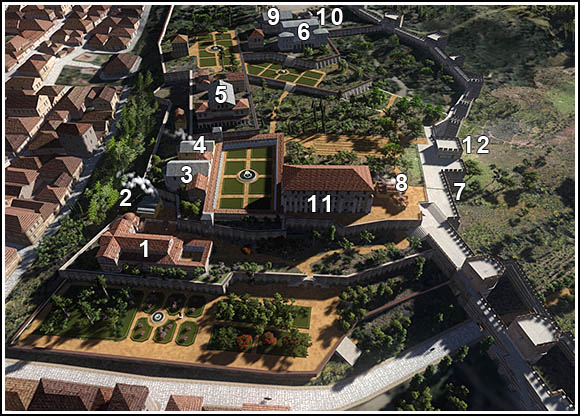
Yes, it is fantasy. Yes, I want to add a fantastic element. But I also prefer the fantastic grounded in the historical, using history as a foundation. Places like the Imperial Domus are much more like the many-roomed Tower of Ashaba... but they are the exception, not the rule. They are the Palaces of the Blachernae, not the domains of local lords.

Blachernae, the home of the Byzantine emperors