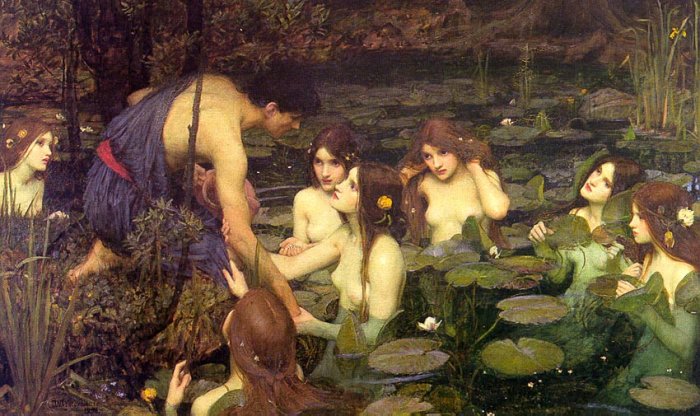
I think anyone who stops to consider the playable elf for a little while will recognize the central mythological problem with playing them. The same might be said of dwarves, but the mythological origins of dwarves are less clear in modern culture—while we can look through Tolkien to find older elves, and while many authors have done so because the idea of a Fair Folk is a pervasive and unsettling element of Celtic myth-cycles—we have trouble seeing through Tolkien to find the Norse dvergr.
Which leaves us, now, at this juncture, with elves to talk about. We have two radically different conceptions of elves that stand at odds with each other: the playable Dungeons and Dragons fantasy-type elf, and the elf of mythology. Mythologically, stemming from those cycles, elves are a dangerous, capricious, inhuman, almost monstrous people inhabiting a land that exists side by side with ours but through a sort of veil. These Fair Folk or Good Folk (and you must always call them that for fear of offending them) are not the mystic tree-hippies or detached sorcerers of modern fantasy.
In their mythological origins, elves are much more akin to awful spirits than they are to men. Their ways are inscrutable. They may invite a commoner to dance and refuse to let them go until they die of de-hydration. They may causally invite someone over for a few drinks only for that person to find that the world has passed beyond all recognition and a hundred years have gone by while he was away. Elves are capricious, and seem incapable of understanding human beings.
I've striven to integrate this portion of the elvish mytho-spirit into the elves of the 10th Age. They are long-lived, and therefore find the tribulations of men somewhat amusing. They form deep attachments that they can break in an instant. They are fond of deals and tricks, and often have a somewhat perverse sense of humor when it comes to the other races. Still, this doesn't cure the main problem.
The tension is that elves of Celtic myth were about fear and the unknown and they were essentially inhuman. In a game like D&D, we're asking people to portray these roles, to inhabit them, not only as an actor might inhabit a role, but as a method actor might. How can we properly expect players to be elves as depicted in the myths? For that matter, how could we even want that, considering it would make playing the game as a party impossible or unpleasant?
Some of the work might be done in separating out the other "fair folk" from the elves and giving playable elves a more grounded base in the everyday realm of mortals. Pixies, nixies, sprites, griggs, atomies, leprechauns, and various others can still fill the traditional trickster role without too much trouble.
In order to make elves playable, they must be at least somewhat tame. They must be brought back from that terrifying wild place that they reside in mythology. Yet, I would argue, in order to preserve that which makes them elves, they cannot be wholly tame. They must be at least somewhat strange, other, outre, and unapproachable. To strike this balance... ah, that is the problem with elves.
Showing posts with label literary theory. Show all posts
Tuesday, February 23, 2016
The Problem With Elves
Labels:
10th Age,
adnd,
elves,
history,
literary theory
Monday, January 27, 2014
D&D as Picaresque
I've often said that the problem with comparing the unfolding of the lives in D&D to a novel is that roleplaying the life and times of adventurers lacks the common cohesion of theme and structure that novels seek. If the progression of a D&D can be compared to any kind of novel, it is the picaresque alone. The more I considered that position, the more I realized how well it fit. Indeed, the term itself comes from the Spanish "picaro," meaning rogue.
Let us take some picaresques as consideration—Barry Lyndon, for example. Redmond Barry is a self-serving "adventurer" who fights in a duel, runs away from the law, joins the British army, deserts the British army, is press-ganged into the Prussian army, becomes a police spy in Berlin, turns into a gambler and cheat, and then marries wealthily enough to hope to obtain a Peerage back in England. Not bad for a man of humble country gentry means. What I'm interested here is the amount of deceit and underhandedness as well as the apparent social mobility of the picaro. These are adventurers in both senses of the term—the commonly accepted one and the one popularized by D&D. While there are plenty of upright and noble PCs, they are more often than not cast in the role of the picaro.
The adventurers of the picaro tend to look something like those of the average D&D group as well. They get into episodes of trouble and either by luck or cleverness they weasel their way out. They search for money and status, cross class boundaries with more ease than the other members of their society. They're generally social outsiders, as adventurers are bound to be.
The main reason that picaresque comes to mind when talking about D&D (or many other roleplaying games of the same type) is because it's generally episodic. One episode occurs and then is followed by another but they aren't connected by a larger set of themes, much like one adventure and another. Certainly there are causal relationships between adventures, but they make a very loose tapestry of cause and effect. Yet somehow, the picaro and the adventurer share more than just this narrative structure, this "episode of life" storytelling. Perhaps it's because of the way The Dying Earth was written (particularly Cugel's Saga) or perhaps it's just a result of the structure, but I'm of a mind to think that it has something to do with the relationship between pulp fantasy and picaresque.
Many picaresques are in first person (like a roleplaying experience), about devious or cunning characters, deal with those who are forced to survive on luck and wits alone, who get into and out of trouble frequently, who break social conventions and boundaries, and whose lives are eventually about adding up individual episodes together. Is D&D not the perfect picaresque? It's hard to say if it was designed to be, but it certainly appears to be made for it.
Let us take some picaresques as consideration—Barry Lyndon, for example. Redmond Barry is a self-serving "adventurer" who fights in a duel, runs away from the law, joins the British army, deserts the British army, is press-ganged into the Prussian army, becomes a police spy in Berlin, turns into a gambler and cheat, and then marries wealthily enough to hope to obtain a Peerage back in England. Not bad for a man of humble country gentry means. What I'm interested here is the amount of deceit and underhandedness as well as the apparent social mobility of the picaro. These are adventurers in both senses of the term—the commonly accepted one and the one popularized by D&D. While there are plenty of upright and noble PCs, they are more often than not cast in the role of the picaro.
The adventurers of the picaro tend to look something like those of the average D&D group as well. They get into episodes of trouble and either by luck or cleverness they weasel their way out. They search for money and status, cross class boundaries with more ease than the other members of their society. They're generally social outsiders, as adventurers are bound to be.
The main reason that picaresque comes to mind when talking about D&D (or many other roleplaying games of the same type) is because it's generally episodic. One episode occurs and then is followed by another but they aren't connected by a larger set of themes, much like one adventure and another. Certainly there are causal relationships between adventures, but they make a very loose tapestry of cause and effect. Yet somehow, the picaro and the adventurer share more than just this narrative structure, this "episode of life" storytelling. Perhaps it's because of the way The Dying Earth was written (particularly Cugel's Saga) or perhaps it's just a result of the structure, but I'm of a mind to think that it has something to do with the relationship between pulp fantasy and picaresque.
Many picaresques are in first person (like a roleplaying experience), about devious or cunning characters, deal with those who are forced to survive on luck and wits alone, who get into and out of trouble frequently, who break social conventions and boundaries, and whose lives are eventually about adding up individual episodes together. Is D&D not the perfect picaresque? It's hard to say if it was designed to be, but it certainly appears to be made for it.
Tuesday, January 7, 2014
The New Fantasy
It's an undeniable fact that "realism" in the form of verisimilitude seems to fall under the governance of the pendulum of popularity. I would argue that, at least in terms of literature, the most "realistic" of fantasy is actually historical fiction. This strains verisimilitude not at all—there is no need to accept a premise other than that the author is presenting a more-or-less accurate depiction of historical record. The further from historical fiction one strays, the more precepts must be taken for granted.
Hewing close to verisimilitude tends to produce the range of naturalistic works, such as those Gygax championed. Understanding the ecosystem of foreign and unbelievable lands makes them less unbelievable and grounds them in fact. It's no secret that I'm a champion of the Fewer Precepts model; the less an audience is asked to swallow, the easier it is to enjoy the story and forget that its a story. Character motivation, for me, is one of the worst things to bungle and the easiest way out of a tale. I'm more than willing to accept the existence of magic, of trolls, of whatever else. Of course, I'd rather not have to also take it for granted that those things don't follow rules, but I'm allowing myself to be sidetracked by one of my favorite subjects to harp on.
The driving point of all this is that I feel that the Song of Ice and Fire series represents a step in a different direction for fantasy literature. Steps of a similar ilk were taken with the Black Company (though these focused on verisimilitude of character and warfare rather than setting) and then much much further with Cook's second series, The Instrumentalities of the Night. I guess what I'm saying is maybe there's a place for a new kind of fantasy. I don't really know. I'm exploring the idea right now, as I'm sure you are now that I've mentioned it (or perhaps you're secretly fuming that I would suggest it).
I love Tolkien. He is the archetype, the universal model upon which I base my decisions. I love his writing. But it doesn't fit this idea of the New Fantasy. It's a mythic fantasy that he's writing, one informed by the mythology of Europe and the ideology of a particular time and a particular place and one slightly idiosyncratic man. Perhaps there can exist, alongside this, a clutch of secondary world literature that is less mythic in scope. Perhaps books about secondary worlds need not include wizards and wars without end, brutal night or the pinnacle of human achievement. Perhaps perhaps perhaps a new type of fantasy is dawning.
Or perhaps not.
Hewing close to verisimilitude tends to produce the range of naturalistic works, such as those Gygax championed. Understanding the ecosystem of foreign and unbelievable lands makes them less unbelievable and grounds them in fact. It's no secret that I'm a champion of the Fewer Precepts model; the less an audience is asked to swallow, the easier it is to enjoy the story and forget that its a story. Character motivation, for me, is one of the worst things to bungle and the easiest way out of a tale. I'm more than willing to accept the existence of magic, of trolls, of whatever else. Of course, I'd rather not have to also take it for granted that those things don't follow rules, but I'm allowing myself to be sidetracked by one of my favorite subjects to harp on.
The driving point of all this is that I feel that the Song of Ice and Fire series represents a step in a different direction for fantasy literature. Steps of a similar ilk were taken with the Black Company (though these focused on verisimilitude of character and warfare rather than setting) and then much much further with Cook's second series, The Instrumentalities of the Night. I guess what I'm saying is maybe there's a place for a new kind of fantasy. I don't really know. I'm exploring the idea right now, as I'm sure you are now that I've mentioned it (or perhaps you're secretly fuming that I would suggest it).
I love Tolkien. He is the archetype, the universal model upon which I base my decisions. I love his writing. But it doesn't fit this idea of the New Fantasy. It's a mythic fantasy that he's writing, one informed by the mythology of Europe and the ideology of a particular time and a particular place and one slightly idiosyncratic man. Perhaps there can exist, alongside this, a clutch of secondary world literature that is less mythic in scope. Perhaps books about secondary worlds need not include wizards and wars without end, brutal night or the pinnacle of human achievement. Perhaps perhaps perhaps a new type of fantasy is dawning.
Or perhaps not.
Tuesday, August 28, 2012
Dungeons and Hyper-reality
I'll bet you were just itching to get back to esoteric nonsense here at the Mug, weren't you? You've started to shift uncomfortably, looking at modules and reports of GenCon, checking down statlines and downloads and think to yourself "When is he going to write another essay that's mostly intellectual masturbation?" Well, my friends, you've come at the right time because here it is: an exploration of roleplaying games (particularly Dungeons and Dragons) and hyper-reality.
Before we launch into the topic, it would help to define our terms. What exactly is hyper-reality? It sounds like an easy enough word to parse, but it can hide a whole bundle of meanings. Here I'm using it in the same sense as Umberto Eco and the semiologists: hyper-reality is a reality that is "more real than real." It's a reality so widely accepted as real (from constant input through media sources of all kinds) that it seems more real than actual reality. It's preferable to reality, better than reality, and overwrites reality itself.
How can D&D be "more real than real?" Well, one of the things that we constantly struggle with here at the Frothing Mug is the collapse of an aesthetic that focuses on simulation of real situations. When someone in one of my games wants to know how much a barrel full of water weighs, I look that up not in a rule book but with a calculator and some estimates on volume. When someone wants to know how long it takes to build a castle, I do research and establish rules. This approach is the least hyper-real that I can get. Sure, no one suddenly has to pee while fighting goblins, but we can assume that bathroom breaks generally take place between the action. The fact that they don't happen as part of the action is the first concession to hyper-reality. My D&D games are better-than-real because you're never suddenly caught unawares by the need to relieve yourself.
Before we launch into the topic, it would help to define our terms. What exactly is hyper-reality? It sounds like an easy enough word to parse, but it can hide a whole bundle of meanings. Here I'm using it in the same sense as Umberto Eco and the semiologists: hyper-reality is a reality that is "more real than real." It's a reality so widely accepted as real (from constant input through media sources of all kinds) that it seems more real than actual reality. It's preferable to reality, better than reality, and overwrites reality itself.
How can D&D be "more real than real?" Well, one of the things that we constantly struggle with here at the Frothing Mug is the collapse of an aesthetic that focuses on simulation of real situations. When someone in one of my games wants to know how much a barrel full of water weighs, I look that up not in a rule book but with a calculator and some estimates on volume. When someone wants to know how long it takes to build a castle, I do research and establish rules. This approach is the least hyper-real that I can get. Sure, no one suddenly has to pee while fighting goblins, but we can assume that bathroom breaks generally take place between the action. The fact that they don't happen as part of the action is the first concession to hyper-reality. My D&D games are better-than-real because you're never suddenly caught unawares by the need to relieve yourself.
Labels:
10th Age,
adnd,
hyperreality,
literary theory,
semiology,
theory,
Umberto Eco
Monday, July 2, 2012
On Fantasy and Escape
Tolkien once famously said of fantasy literature: "Fantasy is escapist, and that is its glory. If a soldier is imprisioned
by the enemy, don't we consider it his duty to escape? ... If we value
the freedom of mind and soul, if we're partisans of liberty, then it's
our plain duty to escape, and to take as many people with us as we can!"
I hate to disagree with the grandmaster of modern fantasy literature, but disagree I do. Not, of course, concerning his value of escapist literature (which I suppose is alright), but rather with his judgement that fantasy is necessarily escapist at all. George R. R. Martin, in an interview, explained why so many beloved characters died in ASIAF; he said it was not comfort literature. I would argue that Lord of the Rings isn't comfort literature either.
Fantasy does not have to be light-hearted, uplifting, or hopeful. What good is the escape of following Ned Stark? No good at all, in terms of escapism, I would argue. But the same can be said of poor Frodo, who is in essence a tragic hero: he wins only to also lose. While Middle Earth is saved from the machinations of the Dark Lord, Frodo himself is hollowed out and ruined by the experience. He sacrifices the things that make his life worth living in order to protect Middle Earth—he sacrifices himself.
This isn't escapism. Fantasy literature can be as true and vital and vibrant and necessary as any other genre. Just because it takes place in a secondary world doesn't mean that there are not truths about our world there. Indeed, Derrida would scoff to think that you could ever construct a document that was not riddled with hints and truths of the author's society and intention. Deconstruct Lord of the Rings and you will find the truths that Tolkien thought were essential to humanity.
I'm tired of hearing slanders made against fantasy literature. What exactly irks people about it? That it's not history? I'm sorry to say that most novels are not history. That novel you read about a love story? It didn't really happen. Not only that, but it probably couldn't have happened. What about the authors we most value as part of the English corpus? Shakespeare? Well, again, I'm sad to tell you that Shakespeare (while he didn't make up his stories, since he wasn't a great plot-author so instead had to take them from other sources) wrote a lot of things that didn't happen.
It seems hypocritical, strange, and almost unbalanced to rage against the fantastic simply because it is fantastic. Sure, you can be angry at bad writing (and I suppose fantasy has been an umbrella for poorly written work for a long time, due to the fact that critics simply dismissed the whole genre and refused to help sift through the shit) but to be angry at the genre of fantasy itself is as senseless as hating adventure, romance, documentary, or any other genre-style.
Fantasy itself is exactly as credible and as real as any other fiction.
I hate to disagree with the grandmaster of modern fantasy literature, but disagree I do. Not, of course, concerning his value of escapist literature (which I suppose is alright), but rather with his judgement that fantasy is necessarily escapist at all. George R. R. Martin, in an interview, explained why so many beloved characters died in ASIAF; he said it was not comfort literature. I would argue that Lord of the Rings isn't comfort literature either.
Fantasy does not have to be light-hearted, uplifting, or hopeful. What good is the escape of following Ned Stark? No good at all, in terms of escapism, I would argue. But the same can be said of poor Frodo, who is in essence a tragic hero: he wins only to also lose. While Middle Earth is saved from the machinations of the Dark Lord, Frodo himself is hollowed out and ruined by the experience. He sacrifices the things that make his life worth living in order to protect Middle Earth—he sacrifices himself.
This isn't escapism. Fantasy literature can be as true and vital and vibrant and necessary as any other genre. Just because it takes place in a secondary world doesn't mean that there are not truths about our world there. Indeed, Derrida would scoff to think that you could ever construct a document that was not riddled with hints and truths of the author's society and intention. Deconstruct Lord of the Rings and you will find the truths that Tolkien thought were essential to humanity.
I'm tired of hearing slanders made against fantasy literature. What exactly irks people about it? That it's not history? I'm sorry to say that most novels are not history. That novel you read about a love story? It didn't really happen. Not only that, but it probably couldn't have happened. What about the authors we most value as part of the English corpus? Shakespeare? Well, again, I'm sad to tell you that Shakespeare (while he didn't make up his stories, since he wasn't a great plot-author so instead had to take them from other sources) wrote a lot of things that didn't happen.
It seems hypocritical, strange, and almost unbalanced to rage against the fantastic simply because it is fantastic. Sure, you can be angry at bad writing (and I suppose fantasy has been an umbrella for poorly written work for a long time, due to the fact that critics simply dismissed the whole genre and refused to help sift through the shit) but to be angry at the genre of fantasy itself is as senseless as hating adventure, romance, documentary, or any other genre-style.
Fantasy itself is exactly as credible and as real as any other fiction.
Labels:
fantasy,
literary theory,
rant,
theory,
writing
Monday, June 4, 2012
Scriptor Liberator
If you're a reader of my work, you can probably tell that I have more than just the average bit of elitism going on in. I've been possessed of a terribly elitist ethic since I was a child, probably because I first went to Catholic School and then to a private boarding school in Cheshire Connecticut. Those sorts of places breed a holier-than-thou attitude. However, I like to think I've done much in the way of distancing myself from some of that posturing.
Something I realized only recently is that I my elitist attitude still lingered when it came to the domain of writing. For a long time, I honestly felt that most people just shouldn't bother. I never understood journals or blogs: what do you get out of them? Who are you talking to? No one! Yet, after starting this blog of my own and discussing it with other people, I have come to the realization that I would continue to write it even if no one was reading it. Now, that's not an invitation to stop following me, since I would certainly become despondent and probably update less, but it remains true.
Friday, May 4, 2012
I've been workin'...
Everyone loves a good story. Stories, after all, are probably the reason why you're roleplaying in the first place. Tolkien, Dunsany, Vance, Cook, Martin, Howard, here are your reasons to pick up a copy of Dungeons and Dragons and play it. They all weave such good stories of the fantastic that one can hardly resist them. Who among us does not wish to emulate the fantasy greats and tell stories of our own? I certainly do. Every time I read some good fantasy I curse that I did not write it, that my own fantasy is not near as engaging or powerful. But here's the thing: I don't take that desire with me into my Dungeons and Dragons games. They just don't seem to be compatible.
"Why not?" you would be very well in asking. What prevents me from writing out the plots that I would otherwise insert into my fiction as adventures? What prevents me from involving my players in the self-same stories that I want to write myself? There are a myriad of reasons, but they can all be summed up with a single idea: the railroad.
You see, stories are not about branching paths and choices. They are about a plot that drives them. Characters in books (other than choose-your-own adventures) cannot make choices other than the ones they do. Sometimes, if an author decides that he does want them to make different choices, he must go back and rewrite large sections of the tale. But there is always an operative theme, motif, and throughline in a book even if you don't always see one. The only themes or motifs that exist in Dungeons and Dragons are that life is cheap, the world is dangerous, and small things matter.
"Why not?" you would be very well in asking. What prevents me from writing out the plots that I would otherwise insert into my fiction as adventures? What prevents me from involving my players in the self-same stories that I want to write myself? There are a myriad of reasons, but they can all be summed up with a single idea: the railroad.
You see, stories are not about branching paths and choices. They are about a plot that drives them. Characters in books (other than choose-your-own adventures) cannot make choices other than the ones they do. Sometimes, if an author decides that he does want them to make different choices, he must go back and rewrite large sections of the tale. But there is always an operative theme, motif, and throughline in a book even if you don't always see one. The only themes or motifs that exist in Dungeons and Dragons are that life is cheap, the world is dangerous, and small things matter.
Labels:
adnd,
books,
encounters,
game master,
literary theory,
players,
preparation,
railroading,
referee,
theory,
video games
Wednesday, March 28, 2012
The Care and Feeding of Henchmen and Hirelings
Since I'm in San Francisco taking in the sites, eating the delicious foods, and all-around enjoying myself, this entry is going to be brief, and on the subject of the invariably put-upon members of any D&D party: the henchmen and hirelings. I'm heading to the MAP conference in Santa Clara later in the week to give a paper on the Liber Eliensis, so I'm also pretty busy getting that up to snuff for presentation insofar as the performative aspects of giving papers go.
Modern incarnations of D&D have forgotten all about these characters; in a dramatic situation, it is thought of as bad form to upstage the main character by giving the action to some lesser fellow. Of course, this is a rule mostly followed in action movies and obeyed to a much lesser extent in serious literary works. However, since a lot of people play D&D like an action movie, and because most modern RPGs exist to paint the player as the prime actor, the idea of henchmen and hirelings have fallen by the wayside. We are warned to be wary of upstaging PCs with NPC actions, lest they feel as though they didn't accomplish the important tasks in the game. Mike at Really Bad Eggs wrote about something similar recently, concerning the primacy of PC actions (and whether or not it really needs to be Prime).
This attitude springs, I think, from the same abuses that most of the other Player's Rights issues arose from. Indeed, I think this is a cornerstone of the Player's Rights movement—that nebulously defined set of core rights that no GM should violate. It is probably true that Bad GMs have foisted characters onto parties, characters that had no right to be there, who conquered all the foes and took all the treasure and essentially made the game into a masturbatory exercise of power. Again, like all Player's Rights issues, I think this is a problem with bad GMs rather than with rules and should be handled as such; the players do not necessarily have a right to primacy of action, but they have demanded it to head off GM abuse.
This has led to the decline of the henchman. I'm guilty, myself, of punishing parties that want to use hench- and hirelings. I once angrily informed a player that they would have to split their xp with their hirelings (even animals, were they to buy them)! What fit of foolish Player's Rightisms sent me into paroxysms of rage I cannot begin to say. My thought was that the players should accomplish their achievements ALONE, without the aid of GM assistance in the form of hired hands. This is patently ridiculous! These penalties were wrong-headed of me; I might consider splitting the xp a few additional ways (ie, count hirelings as members of the party) but to force someone to cut their own xp with a hireling is just nonsense.
Hirelings and henchfolk are an important resource, and no one should be docked for using them.
Modern incarnations of D&D have forgotten all about these characters; in a dramatic situation, it is thought of as bad form to upstage the main character by giving the action to some lesser fellow. Of course, this is a rule mostly followed in action movies and obeyed to a much lesser extent in serious literary works. However, since a lot of people play D&D like an action movie, and because most modern RPGs exist to paint the player as the prime actor, the idea of henchmen and hirelings have fallen by the wayside. We are warned to be wary of upstaging PCs with NPC actions, lest they feel as though they didn't accomplish the important tasks in the game. Mike at Really Bad Eggs wrote about something similar recently, concerning the primacy of PC actions (and whether or not it really needs to be Prime).
This attitude springs, I think, from the same abuses that most of the other Player's Rights issues arose from. Indeed, I think this is a cornerstone of the Player's Rights movement—that nebulously defined set of core rights that no GM should violate. It is probably true that Bad GMs have foisted characters onto parties, characters that had no right to be there, who conquered all the foes and took all the treasure and essentially made the game into a masturbatory exercise of power. Again, like all Player's Rights issues, I think this is a problem with bad GMs rather than with rules and should be handled as such; the players do not necessarily have a right to primacy of action, but they have demanded it to head off GM abuse.
This has led to the decline of the henchman. I'm guilty, myself, of punishing parties that want to use hench- and hirelings. I once angrily informed a player that they would have to split their xp with their hirelings (even animals, were they to buy them)! What fit of foolish Player's Rightisms sent me into paroxysms of rage I cannot begin to say. My thought was that the players should accomplish their achievements ALONE, without the aid of GM assistance in the form of hired hands. This is patently ridiculous! These penalties were wrong-headed of me; I might consider splitting the xp a few additional ways (ie, count hirelings as members of the party) but to force someone to cut their own xp with a hireling is just nonsense.
Hirelings and henchfolk are an important resource, and no one should be docked for using them.
Monday, March 12, 2012
Medieval Stasis and the Status Quo
![]() |
| Those Scythians! |
The first issue will be identifying what a medieval setting even means. As a medievalist I have a very specific view on the time period, which perhaps colors my perceptions of this argument. What many would classify as medieval (Greyhawk, the Forgotten Realms, Dragonlance) I would tend closer towards calling pure fantasy. They have a semi-medieval base, but each of these settings makes liberal use of elements from the Renaissance as well as wholly contrived ones in such a way as to truly obscure anything about them that is particularly medieval.
Subscribe to:
Posts (Atom)