So let's talk about all the various types of rebellion that occurred in the medieval world.
We've already examined the types of popular revolution that happen when food prices are shaken, but there are other forms of rebellion and replacement of the political order than merely the overhauling revolution.
There are several things that lead to rebellion, a laundry list of factors as it were. These include but are not limited to:
(a) A sizable intelligentsia unable to access political efficacy.
(b) Insecurity in food supply or income.
(c) In the medieval context of polities that are reliant on personal charisma, personal disagreements or other forms of friction between individuals.
(d) Growing pains after an attempt (successful or not) at centralization.
Several of these can be consolidated into a single element, mainly: weakness of the central authority. The reason for this is, of course, that someone in the kingdom always has a better idea at how things should be run, or a more legitimate claim to the title, or just more ruthlessness. Rebellion and insurrection are in fact native forces that simply wait for the center to fail. They are the entropic principle of a kingdom (or, in modern terms, a state). As wood rots and the arrow of time flies ever forward, the death of the kingdom is already contained within it, waiting for release.
The most common types of rebellion in medieval polities are, of course, those that focus on one of the following issues:
(i) inheritance grievance
(ii) centralization grievance
(iii) religious grievance
(iv) interpersonal tension
All of these issues require an alternative pole to the king to coalesce and take form. This can be the king's paternal uncle, for example, or a brother or son. Paternal uncles were particularly dangerous in the very early middle ages, often killing their brothers' sons in order to take over. Brothers can be equally treacherous—take, for example, the unification of Frankia that relied upon Charles packing his son off to the monastery and fortuitously watching Carloman die.
We can take an archetypical rebellion as a pattern, namely the infamous Anarchy that occurred during the realm of King Stephen. Now, this analysis isn't quite as rigorous as, say, a historical book on the subject. I may miss some of the root causes of the rebellion, but I can at least give the outline.
King Henry, who succeeded William Rufus, who succeeded William the Conqueror, had a son named Henry and a daughter named Matilda (or Maude). Maude was married to the Holy Roman Emperor, who later died, and then remarried to Geoffrey of Anjou. When Henry Adelin, King Henry's son, died in the sinking of the White Ship, King Henry demanded oaths of all his barons that they would crown the so-called Empress Matilda queen after his death.
However, he died fighting in Normandy and his cousin, Stephen of Blois, announced that on his deathbed Henry had named him the heir, following in a long tradition of truths as told by his ancestors, like William the Bastard (that's sarcasm, kid).
Anyway, he rushed to London and got himself proclaimed king. However, Maude still had a number of followers among the barons who grudgingly accepted his kingship. Her half-brother, Robert Earl of Gloucester (also Henry's bastard), began sowing the seeds of rebellion early in Stephen's rule and drawing her loyal followers to him.
When the time was right, Robert went into open revolt, and David, King of Scotland (a perennial thorn in Stephen's side) aided him by invading. David had already invaded once, as he was Matilda's uncle (and was probably using that chance to make a political grab of land in the north of England). Notice this theme: Matilda, the pole of legitimizing succession, gives David a claim to invade. Whether or not he really wanted Matilda to succeed her father is open to debate; though, that would also be wise, as it would create a loyal ally to his south.
Stephen was having troubles with Wales and his coffers were emptied out when Robert rebelled. Whether it was the chance Robert needed or whether Stephen appeared weak and ineffectual, thus driving more lords into Robert's arms, is uncertain. Whatever the reason, as soon as the center was weak enough, the revolt began.
Matilda was its figurehead, but Robert was its heart. He could never be king—his illegitimacy prevented it. Matilda, however, was a convenient figure to rally around.
In the unfolding of the Anarchy, we can see at play the interpersonal relationships of powerful medieval figures leading the road to war. This is a problem of (i) and (iv), triggered by a general weakness in the central polity due to raiding and expenditure of silver.

Ruminations on fiction, roleplaying, and assorted irritants.
Showing posts with label rebellion. Show all posts
Showing posts with label rebellion. Show all posts
Wednesday, July 22, 2015

Monday, July 20, 2015
The Dreadful Security of Food
Bastille Day was last week. I have a soft spot for the French Revolution in my heart, being torn between the Jacobins and the Hebertists on different days myself. But re-reading all about the Revolution of 1789 has reminded me of a dark truth: rebellion, revolution, and insurrection are the children of want, not of political need.
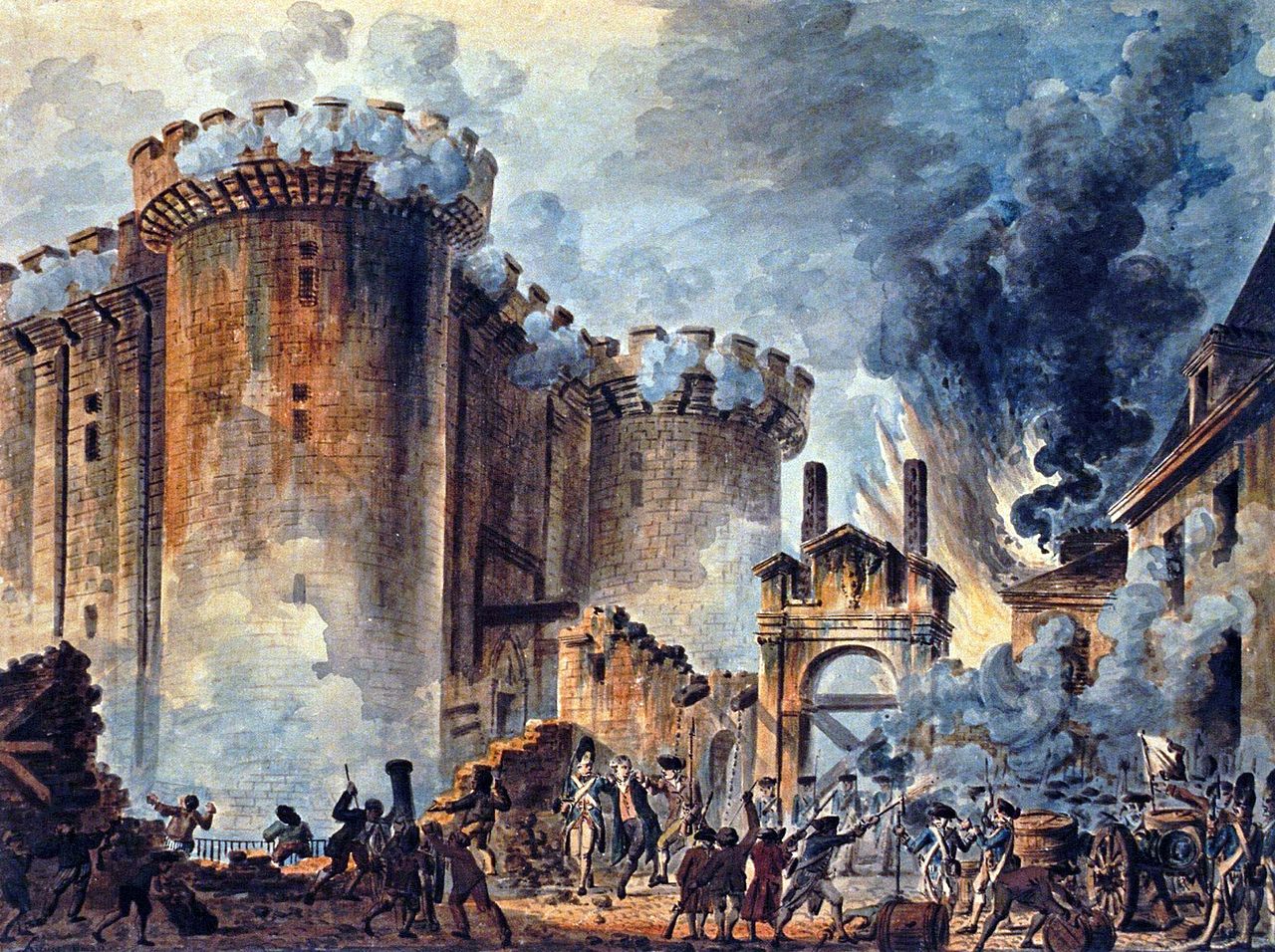
While it's true that somebody always hates the king, they rarely have the power to upset the political order in the every day course of events. True, they may plan a long coup, build up power to launch a rebellion composed of their loyal vassalmen, but there is always a trigger. The weakness of the social order must be made manifest in some way before the trap can be sprung. The iron, as they say, must be hot.
Political insurrection of that type must gravitate toward a legitimate or semi-legitimate figure of power. This is why people like princes of the blood, uncles, aunts, sisters, brothers, or other such relationships are so dangerous in a monarchic semi-feudal land. They represent poles of power with at least the patina of legitimacy. If you're going to kill the king, you can't very well sit on his throne and say, "Well, now I'm the king," no matter what Game of Thrones tells you. You need to have some claim at legitimacy going for you, even if it's hilariously attenuated.
The kind of revolutions we're talking about today, however, don't occur in such a planned manner. The revolution, for example, depicted in The Hunger Games is one that's really organized and fed by a shadow society for decades. That doesn't happen. What happens is that ideologues exist and foment their malcontent, but the people fail to rise up. They write angry pamphlets and letters, they preach in the streets, they preach from the pulpits, whatever they do, but the people don't follow them.
Until food is hard to come by.
When food prices start to rise, the social order begins to crumble. People really care about being able to afford to eat. Famine and plague are great ways to mobilize an angry populous. Tax riots occur not when the taxes increase, but when the ability to feed families is reduced. The price of wheat in the Paris commune went from 50% of a worker's wage to 80% in the course of a month. That kind of inflation is what causes men to go mad. Women too.
If you want to mobilize some mass social chaos capable of not only toppling a monarch but utterly replacing him with an entirely new political system... just throw some vocal ideology in there with skyrocketing food prices. Or wipe out the harvests one year. These things invariably lead to the kind of suffering that people just can't endure in silence.
Subscribe to:
Posts (Atom)